Why You Should Test Every Foundation and HVAC Zone for Radon
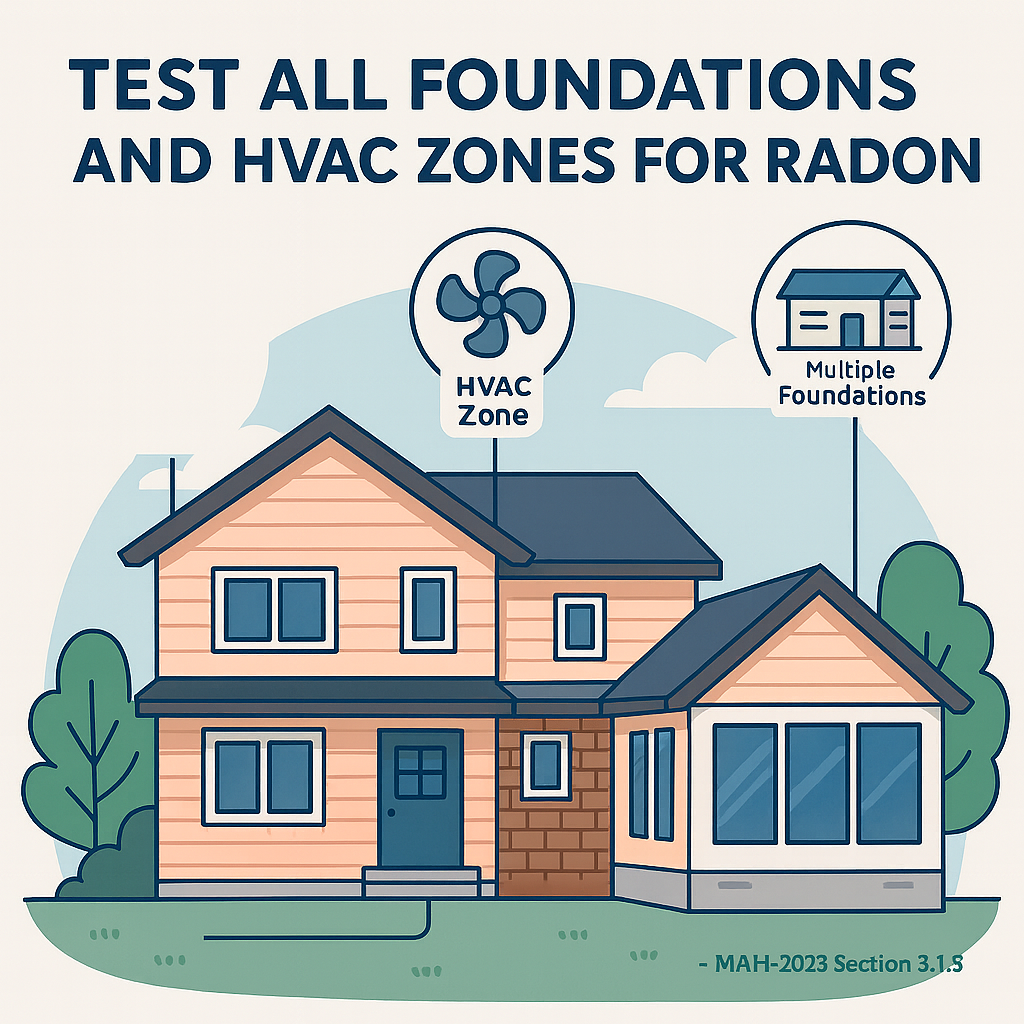
When it comes to radon testing, one size definitely does not fit all. Many homeowners and even some professionals assume that placing a single test device in the basement will give an accurate picture of a home's radon levels. But the ANSI/AARST MAH-2023 standard offers clear guidance that goes beyond the basics—and for good reason.
The Standard Says: One Test Might Not Be Enough
Section 3.1.3 of the MAH-2023 standard encourages additional test locations in several scenarios. Here's what it says:
"Additional test locations are specifically recommended for:
a) each area that exceeds 2,000 square feet on the level of the home being tested;
b) each area of the home served by a different heating and cooling system;
c) each unique foundation area. This recommendation includes split-level foundations or where slab-on-grade rooms attach to basement or crawl space areas."
The reasoning is simple: radon levels are not evenly distributed throughout a home. One area may have high levels while another remains low—especially if the home includes different types of foundations (like a slab-on-grade next to a crawlspace), or separate HVAC zones that affect how air moves through the structure.
Real-World Risk: Why Skipping Extra Tests Could Be Costly
Imagine this: you're buying a home with a basement and a sunroom built on a slab. A test in the basement comes back low—but no test is done in the sunroom. After you move in, you find out that radon levels in that slab-on-grade area are above the EPA action level. Now you're on the hook for mitigation, and you may be kicking yourself for not running that extra test.
This isn't just a hypothetical—it happens all the time, especially in homes with complex layouts or partial additions.
What About Zoned HVAC Systems?
Homes with multiple HVAC zones also pose a unique challenge. Because radon moves with air, separate HVAC systems can create different pressure dynamics in different parts of the home—making radon more likely to enter or accumulate in one zone than another.
By testing each zone individually, you get a clearer picture of how radon behaves throughout the property—and a better sense of where mitigation (if needed) should be focused.
Our Approach: Testing with the Standard in Mind
At Smart Home Radon, we follow ANSI/AARST protocols not just because it's the industry gold standard—but because you deserve the full story before making decisions about your home. We'll help identify unique foundation areas and HVAC zones, and explain if additional testing is warranted to get the most accurate results possible.
Because when it comes to your family's health and peace of mind, there's no room for guesswork.
About the Author – Daisy Rezende

Daisy Rezende is a nationally certified radon measurement provider, lead paint inspector, and mold investigator. As co-owner of Smart Home Radon and Smart Home Inspects, she brings certified expertise and a passion for healthy housing to every inspection. Daisy actively contributes to national industry standards through her work with the Indoor Environments Association (IEA) and as a voting member of the Radon Mitigation Standards Consortium. Her mission: to improve air quality, educate the public, and support healthier homes across Maryland and beyond.
Read Full Bio